

Kolkata: Digital gold purchases in India surged 69% to 13.5 tonnes in 2025, according to the World Gold Council, underscoring increasing appetite among younger investors for accumulating the precious metal in small denominations rather than buying traditional jewellery.
Digital gold allows consumers to buy, sell and hold bullion online without taking physical delivery, with investments starting from as little as Re 1. Investors buy small quantities of gold through fintech platforms, which providers say are backed by equivalent physical gold stored in secure vaults.
Experts say demand for digital gold can increase sharply if the government introduces rules to reassure buyers that their investments are fully backed by physical gold.
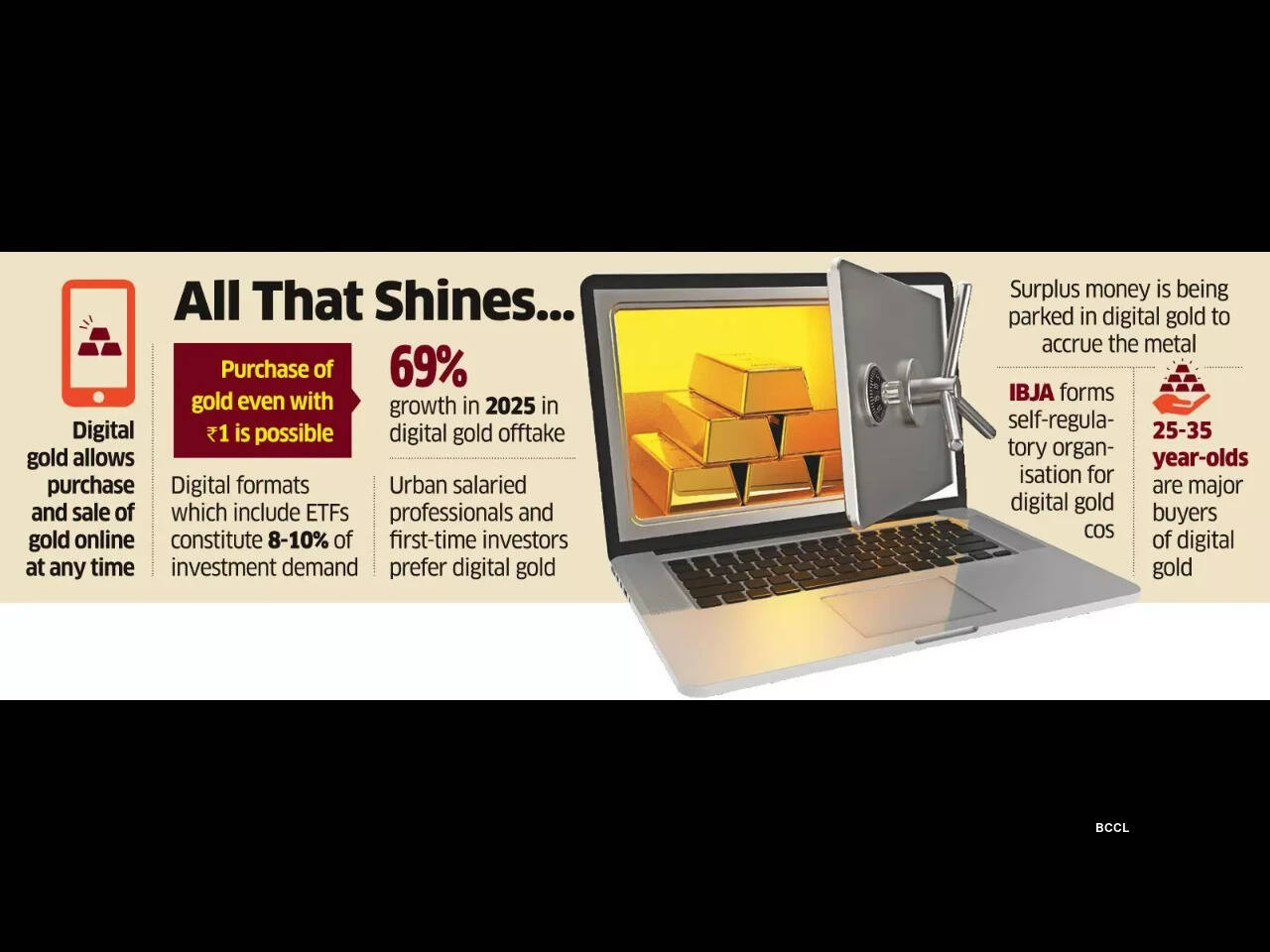
“This is going to go up significantly if the government comes out with regulatory measures to allay fears of consumers whether the gold is actually being bought against their money,” said Sachin Jain, regional CEO, India, World Gold Council. To fill the regulatory vacuum, the India Bullion and Jewellers Association (IBJA) has created a self-regulatory organisation for digital gold firms, which will become operational from April 1 until formal rules are introduced.
“We are seeing a clear shift in how younger Indians approach gold. Traditionally, gold purchasing in India has been largely occasion driven through jewellery, which usually requires larger ticket sizes and includes making charges. Digital gold is changing that behaviour by allowing customers to accumulate gold gradually in much smaller amounts,” said Rhea Chaterji, co-founder and chief operating officer, SafeGold.
Gold on Monday traded around ₹1.56 lakh per 10 grams, down about ₹2,225, after a series of record highs.
Rising prices are also altering buying behaviour. “Instead of waiting for prices to fall before making a large purchase, many investors continue buying smaller amounts over time. Our core demographic of 25-35-year-olds is particularly active in this segment. During periods of economic uncertainty, we often see stronger participation from this group as gold continues to be viewed as a stable store of value and a way to diversify savings,” said Chaterji.
Overall gold demand in India fell 11% to 710.9 tonnes in 2025, according to the World Gold Council. Jewellery consumption decreased 24% to 430.5 tonnes, while investment demand including bars, coins and digital gold increased 17% to 280.4 tonnes. Digital formats remain a small slice of the market. Physical gold, particularly jewellery tied to weddings and festivals, still dominates consumption. Digital gold and exchange-traded funds together account for 8-10% of investment demand, though that share is steadily rising as gold becomes more financialised, said Renisha Chainani, research head, Augmont Gold.
“Consumers are putting their surplus funds in digital gold platforms and over a period of time, they intend to create a corpus,” said Surendra Mehta, national secretary, IBJA. “Also, gold on digital platforms can be bought and sold at any time. It is easy liquidity for the consumers. On the contrary, gold exchange-traded funds can be traded when the exchange opens and closes. What is now required is a regulatory framework for digital gold platforms.”
Industry players say the rally in bullion prices has also played a role in attracting retail investors who can deploy smaller amounts through apps. “The increase in gold prices is fuelling the digital gold demand as consumers can put in a small amount of money to buy gold. The outlook for gold remains bullish despite the current headwinds. Last year, gold gave more than 70% return, which has further spiked the demand for digital gold,” said Chirag Sheth, principal consultant-India, Metals Focus.
The surge in activity has also drawn regulatory attention. In November 2025, the Securities and Exchange Board of India cautioned investors about digital gold products, prompting industry calls for clearer rules. Under the IBJA’s self-regulatory framework, companies will be required to provide independent verification that every gram of digital gold sold is backed by 24-carat bullion stored in vaults.
The government is also studying potential regulations. Jain said the Arun Jaitley Institute of Financial Management has completed substantial work on a framework for digital gold firms. “The proposal is with the government now and the finance ministry is currently working on it. We are hoping to hear from the government soon,” he said.